www.baader-observatories.com



The former GM2000 QCI mount from 2004
My interest in astronomy began already in my youth. However, it was to take decades before I decided to really get into this hobby. My first equipment was a 5-inch refractor and an Astro Physics CNC400 mount. I made my observations mainly from my garden at home, just as I still do today. Astrophotography was soon added, because photography was another hobby of mine.
After a few years, the desire arose for an even more stable and higher-capacity mount, which should also have GoTo capability. My previous mount could not do that. During a visit to Baader Planetarium in 2004, I became acquainted with the then completely new GM2000 QCI mount from the Italian manufacturer 10Micron. Right from the beginning I liked the mechanical design and precision, but also the concept of the control system with its many possibilities.
In the showroom, mounts from another well-known manufacturer were also on display for comparison. Here, among other things, I noticed the smooth running of the GM2000, even at high slew speeds.
So I decided on the GM2000 QCI. However, I was told that the firmware for the control and operation was still in the testing stage. I would have the opportunity to participate in the further development of the mount, or rather the control system, through beta tests and my own suggestions. I had actually wanted to buy a “finished” mount, but this kind of participation and involvement in shaping a product appealed to me, especially since I was convinced by the basic concept. In the testing and submission of suggestions for improvement, the manufacturer showed a high degree of willingness to cooperate on well-founded user requests. It was a good collaboration.
I had set up the GM2000 quasi-stationary in my garden. The mount stood permanently outdoors on a pier tripod, covered and protected by a truck tarpaulin. The telescope was only mounted when needed, and the control box and hand controller were also connected only then. In this way, the mount always remained optimally polar aligned, which shortened setup times before an observation.
The mount proved to be robust, reliable, and accurate in tracking. I found the operation with the hand controller extremely practical and clear. The object catalog was very extensive and could be updated from the Internet with regard to comets and asteroids, an invaluable advantage especially when observing “new” objects.
For the firmware update to version 2, I again had the opportunity, together with several colleagues, to work as a beta tester. Here too, the manufacturer was open to suggestions and ideas for improvement, a kind of attitude toward the user that, in my experience, is rather rare.

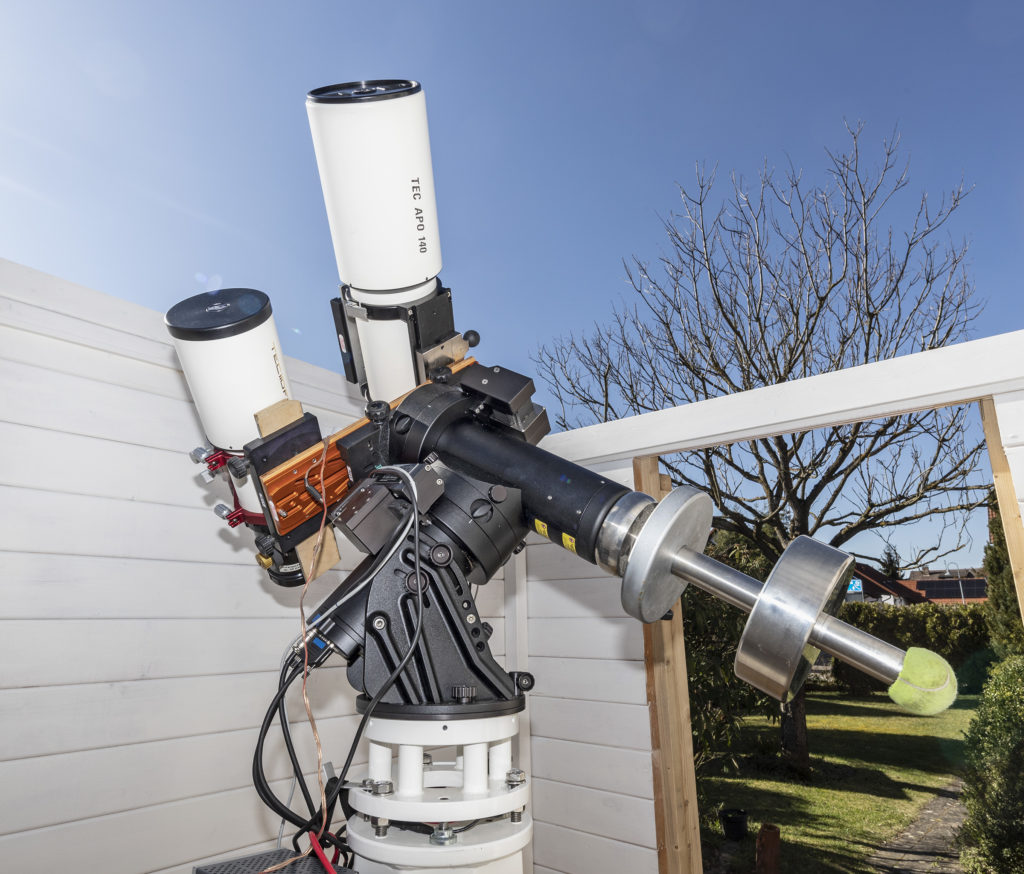
The current GM2000 HPS mount on Baader steel pier
In 2011 the new mount, the GM2000 HPS, was released. At that time I was asked whether I would also like to test this mount in practical use. I gladly agreed, and together with Rolf Geissinger, a renowned astrophotographer, I was a beta tester for this mount. Each of us tested independently, but of course we exchanged information with each other. The result was that both of us, independently of one another, identified a specific malfunction in the mount or the firmware. Eliminating this malfunction apparently proved quite demanding. In any case, the planned market launch of the mount was delayed by almost half a year because of it. I consider that honest and customer-oriented, something that in my experience is found rather rarely.
I subsequently purchased this mount, and the previous GM2000 QCI, which shortly before had again been revised by 10Micron (according to my measurements, the periodic worm error then amounted to only +/- 2"!), was sold through Baader Planetarium — as far as I know to an astronomy club in Baden.
Since mid-2011 I have now had the GM2000 HPS, which I again operated quasi-stationary on the pier tripod.
Up to then I had always observed in the garden from a small terrace behind the garage. But over the years the trees in the neighbor’s garden had grown so tall that my free section of sky became more and more limited. In this situation, my wife and I decided to observe from another place in the garden that allowed a freer view. Unfortunately, there was an apple tree there, which then had to make way. It had not given us any pleasure for years anyway. This gave rise to the idea of building an observatory right away, namely a roll-off roof shed. This integrates very well into our garden and also caused no problems with approval by the building authority. A permanent observatory is something wonderful. Sitting outside in winter as before, perhaps with a cold wind blowing, was something I no longer wanted to put up with. After all, one does not get any younger. When everything is permanently set up and ready for operation, one can also make better use of an unexpected clearing of clouds.
 Planning began in autumn 2018. By the time the project was actually started, it was 2019. The roll-off roof observatory was largely realized by Mr. Stefan Reichmann of www.rolldachuette.de according to my ideas and wishes. The attempt to have the roll-off roof shed built by a wooden shed manufacturer located near us failed. These companies do have party huts, sauna huts, etc. in their range, but they did not dare tackle a roll-off roof. At least they were honest, I have to say. My research then led me to Mr. Reichmann. I had a stable foundation built by a construction company in our town. In autumn 2019, construction of the roll-off roof shed began. At the beginning of 2020, the observatory was ready for operation, even if not yet completely finished.
“First Light” was at the beginning of March 2020. I was lucky to be able to take advantage of a period of good weather. The roll-off roof shed proved itself very well in the process.
The GM2000 HPS is now on a modular steel pier from Baader Planetarium and currently carries two telescopes: a TEC 140 ED and a TEC 110 FL. Because of the permanent installation of the mount, I will now generally do my deep-sky images unguided, which I had already occasionally done before. Now, however, this will probably become the normal case. In the first imaging sessions, at any rate, it worked extremely well. I now do dithering via Maxim DL “via Mount,” since the usual dithering “via Guider” is no longer possible.
I have the impression that with the garden observatory and the GM2000 HPS mount I now have a setup that fits together perfectly.