www.baader-observatories.com


Having your own observatory is certainly the dream of every ambitious amateur astronomer. The advantage of knowing the telescope is permanently set up in one place has benefits that I would no longer want to do without. Unfortunately, as an amateur astronomer, you do not always have the opportunity to realize this for yourself, whether because of lack of space or because of poor lighting conditions where you live. That was also the case for me for many years, ever since I was infected by the astronomy virus at school. So I would make a pilgrimage with all the equipment to a distant observing site. However, over time the equipment became heavier and heavier and the number of various accessories grew. In addition to astrophotography, spectroscopy was also added in recent years to my astronomical activities. This brought with it, above all, a great deal of technical equipment, all of which naturally wants to be connected with cables and, in the end, also has to be controlled with a laptop – the cable mess is practically inevitable. Unfortunately, the power supply is often a limiting factor, especially in winter when the low temperatures take a heavy toll on battery performance.
 The advantages of a mobile setup are certainly that you can reach observing sites with good seeing conditions. However, long travel times often have to be accepted. For me, the greatest disadvantages lie in the fact that the valuable observing time first has to be spent setting up the telescope together with the equipment and performing the polar alignment, which is important for astrophotography. If the calibration of the auto-guiding then does not work right away, there is usually not much left of the actual observing time. As a working person, this effort often held me back from spontaneously setting off in the evening during the work week. Unfortunately, this really only worked when the weather forecast for the weekend was very good.
With the move to the rural Zürcher Oberland, the possibility of setting up a fixed observing site came within reach. My observing site is indeed in the center of the village, but an adjacent meadow promises a good view to the east, south, and west. The seeing cannot be compared with a mountain pass, but for me having an observing site in my own garden has overriding advantages. In just a few steps you are at the observing site, and since the telescope is already set up, you can start immediately.
For me it was clear that the dome should not be integrated into the roof of the house, but that the site should be set up in the garden. Only there is the telescope outside the rising air masses of the house and the telescope is, so to speak, already thermally acclimatized to the outside temperature. At first I had thought of setting up a classic garden shed with a sliding roof, but apart from the not insignificant space requirement, a garden shed simply cannot keep up with the advantages of a good dome:
 After that, the actual planning could begin. Mr. Baader supported me very well already in the early planning phases. So a number of emails went back and forth. Plans for the foundation and the electrical installation were drawn and reviewed by Mr. Baader. In personal discussions in Mammendorf, I was given many tips and pointers for the 2.1 m dome project. After all, the foundation has to be laid correctly and the penetration of moisture should definitely be prevented. In particular, setting up an electrical shaft in the foundation turned out to be worth its weight in gold. In this way, all power supplies find their proper place there and no longer get in the way during operation.
 Once the structural questions had been clarified, the craftsmen could finally begin with the excavation for the foundation. Filling it with gravel, concrete, and a concrete pipe for the cylindrical substructure was then completed quite quickly thanks to the good planning. A bitumen cover and the installation of the electrical and data lines completed the preparatory work.
With marking the north direction on the foundation, my part was finished for the time being. The day on which the Baader team would arrive with the observatory drew near. On one of the hottest days of the year 2013, the crowning conclusion of the project was now to take place. The erection of the dome, including installation of the pier, was carried out professionally by the Baader team. After that, the only work left for me was to line the observatory floor with a wooden floor.

 In the meantime, the telescope has moved into its new home and it gives me great pleasure again and again to put the observatory into operation. Whether cold winter nights or warm summer evenings – the dome can be relied upon. In the times between the observing nights, the optics together with the electronics are optimally protected, regardless of what weather prevails. The dome is sealed quite well – even in strong summer thunderstorms I do not have to worry. With the support of a dehumidifier, a good climate can be achieved in the observatory. In this way, the electronics and the plug contacts are also optimally protected against corrosion.

 In the meantime, I would no longer want to do without the decision for an electric control of the azimuth orientation of the dome roof. In this way, the dome position is synchronized with the orientation of the telescope. The supplied ASCOM driver for the Baader dome runs without disturbance. In this way, the dome slit is always optimally tracked to the telescope orientation, so that manual adjustment of the dome is unnecessary, especially during long exposures. The encoder solution for determining the orientation of the dome roof works reliably even at low winter temperatures.
Since then, the following sequence has been taking place more and more often in my garden:
 But the observatory project is not yet finished. Soon my CGE mount is to be replaced by a version with greater payload capacity. At the exhibition in Mammendorf, I had already found my desired mount from the manufacturer 10Micron. The adapter plate of the steel pier is already prepared for this type. To be continued for sure :)
A big compliment and thanks once again to the professional Baader team.
Thomas Blank CH-8603 Schwerzenbach, March 2014
You can also download this article here as a PDF.
 The advantages of a mobile setup are certainly that you can reach observing sites with good seeing conditions. However, long travel times often have to be accepted. For me, the greatest disadvantages lie in the fact that the valuable observing time first has to be spent setting up the telescope together with the equipment and performing the polar alignment, which is important for astrophotography. If the calibration of the auto-guiding then does not work right away, there is usually not much left of the actual observing time. As a working person, this effort often held me back from spontaneously setting off in the evening during the work week. Unfortunately, this really only worked when the weather forecast for the weekend was very good.
With the move to the rural Zürcher Oberland, the possibility of setting up a fixed observing site came within reach. My observing site is indeed in the center of the village, but an adjacent meadow promises a good view to the east, south, and west. The seeing cannot be compared with a mountain pass, but for me having an observing site in my own garden has overriding advantages. In just a few steps you are at the observing site, and since the telescope is already set up, you can start immediately.
For me it was clear that the dome should not be integrated into the roof of the house, but that the site should be set up in the garden. Only there is the telescope outside the rising air masses of the house and the telescope is, so to speak, already thermally acclimatized to the outside temperature. At first I had thought of setting up a classic garden shed with a sliding roof, but apart from the not insignificant space requirement, a garden shed simply cannot keep up with the advantages of a good dome:
- Good light protection, especially from the street lamps of the village street
- Optimal wind protection
- Protection against dew forming on the optics
- Protection against wind and weather throughout the seasons. Electronics and plug contacts in particular can corrode easily under damp conditions. After all, the telescope is now permanently set up outside the house.

Finished concrete foundation

Electrical shaft in the foundation

Installing the pier

Assembling the cylindrical substructure

with CGE mount

Finished wooden floor
- Open the dome slit.
- Switch on the main power.
- Switch on the mount.
- Start the laptop for controlling the telescope, camera, and dome. Since all devices are permanently set up, only a USB cable is needed to connect the telescope system to the PC.
- Start the planetarium software and the “Dome Controller”.
- Select the observation object and start GoTo.
- Telescope and dome automatically align themselves to the desired object.
- Start camera and guiding.
- Done
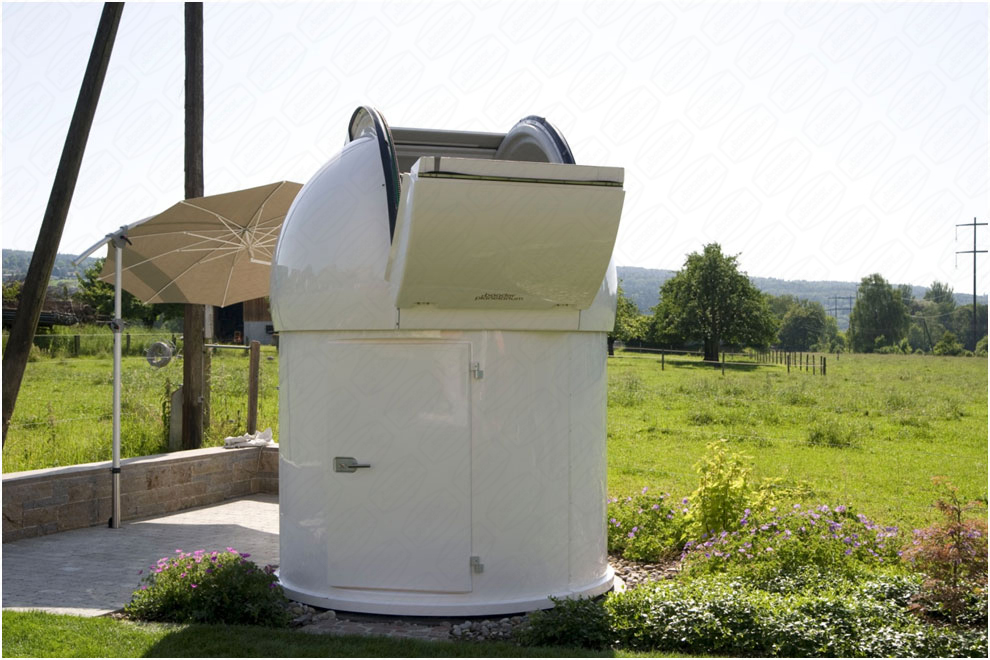
Finished 2.1 m observatory