www.baader-observatories.com


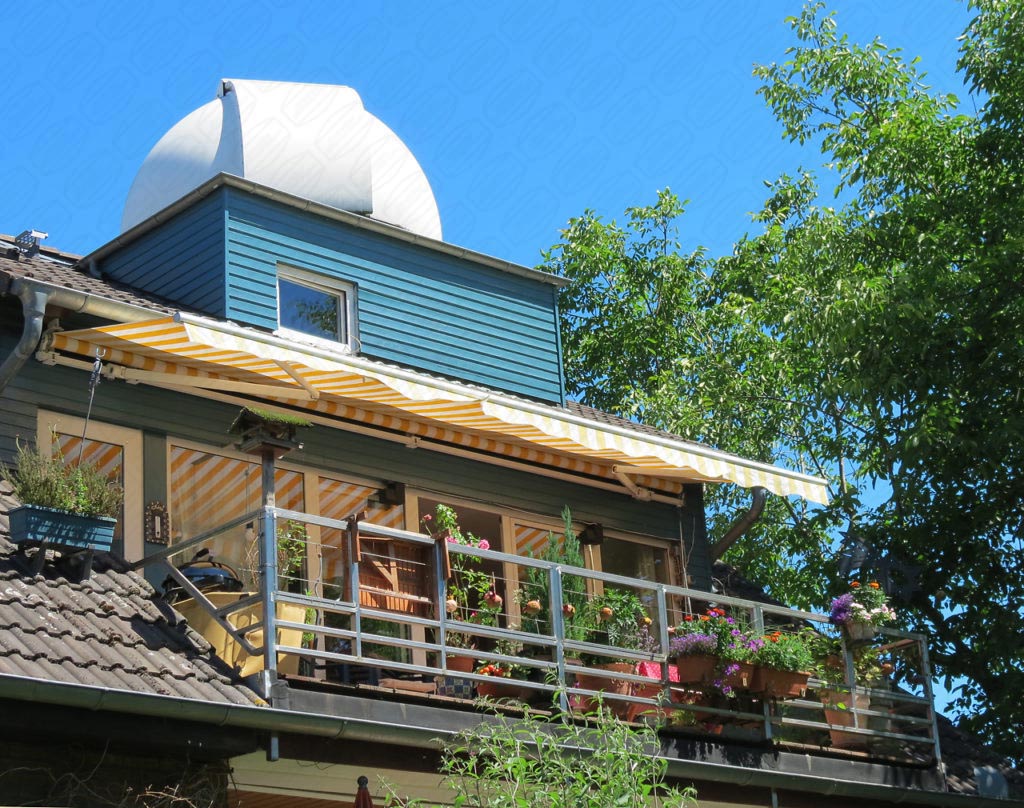
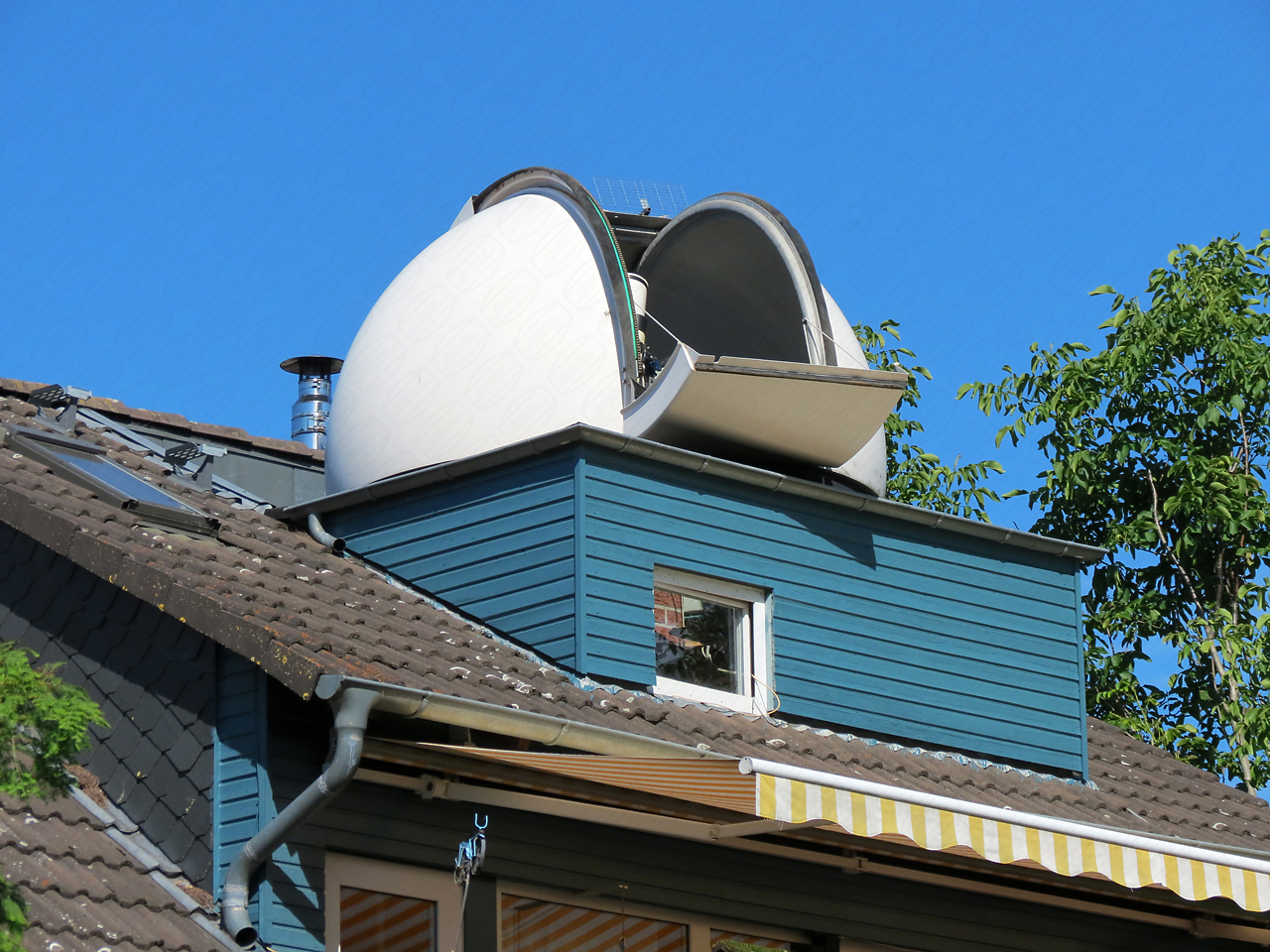
My dome stands on the roof of a two-family house, about 20 kilometers southwest of Hanover as the crow flies. In 1989, my wife and I decided on an extensive renovation of the entire upper floor, and in the course of this a Baader 2.6 m dome was installed on the roof. Until 1989, I had a 1.9 m Baader dome on a self-built hut in the garden.
I chose not to use a matching prefabricated round Baader base for the dome and instead mounted the dome on a square substructure. The square substructure is much more practical than a round one, because it offers an enormous amount of space for cabinets to store various accessories. Access to the dome is via a normal staircase from the roof terrace, which makes it much easier to bring large and heavy telescopes into the dome for testing.
The dome was completely assembled in the garden and then placed onto the substructure with a rented mobile crane. Many years later, a motorized azimuth drive was retrofitted.
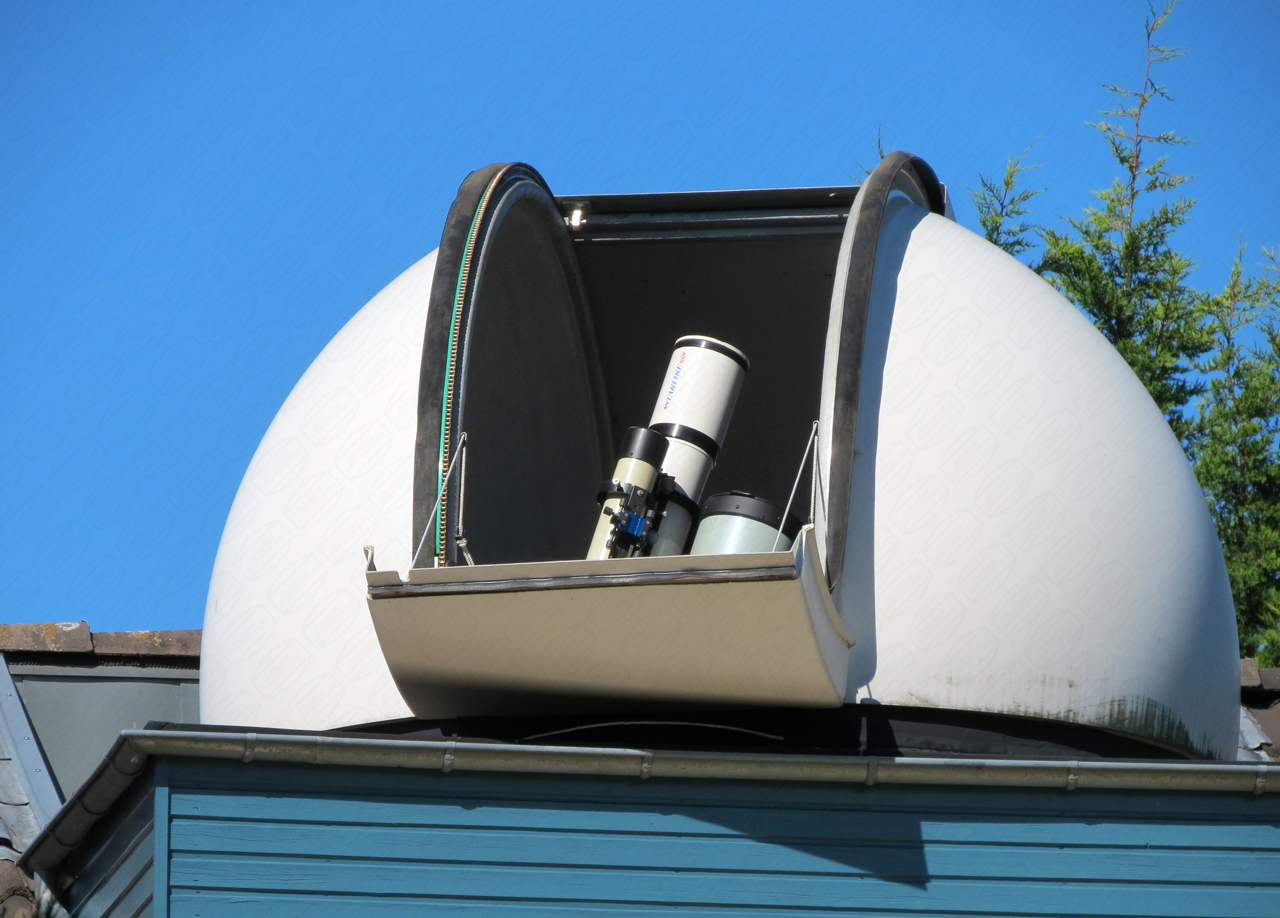
The Astro-Physics mount dates from 1999 and stands on a masonry pier, which in turn is founded on a partition wall down to the lower floor. Permanently mounted is an Astro-Physics EDF refractor with 155 mm aperture and 1085 mm focal length. The telescope is mounted asymmetrically; on the other side there is space for mounting various instruments. Today — 2018 — it is a Celestron Edge HD 925 Schmidt-Cassegrain for recording high-resolution lunar images with video technology.
Since I am very interested in technology, many telescopes have found their place there over the years; from an 8" Newtonian to an 11" Celestron Hyperstar and up to a 16" Keller hypergraph. With the 155 mm AP refractor, many Baader products for solar observation were tested over the years.
The dome has functioned completely without problems since its installation 28 years ago. Every 4 or 5 years, the chain for the slit shutter is oiled with chain spray and the dome is cleaned on the outside. The square substructure also proves very practical during cleaning, because one can walk around the dome safely for about 270 degrees — after all, about 10 m above the ground.
I also look after another Baader “Classic” 3.2 m dome in Namibia, which has also functioned completely without problems since its installation in 2004 under extreme weather conditions there (extremely dry air and heavy rainfall during the rainy seasons). I also supervise there a 3 m and a 4 m dome from a Baader competitor, which have already caused me many technical problems since their installation in 2013.
My dome and the complete construction can gladly be visited by interested amateur astronomers by prior arrangement. Contact details can be obtained through Baader Planetarium.
Dipl.- Ing. Wolfgang Paech im Juli 2018