www.baader-observatories.com
The first experiences with the PlaneWave CDK-20 on GM4000 QCI
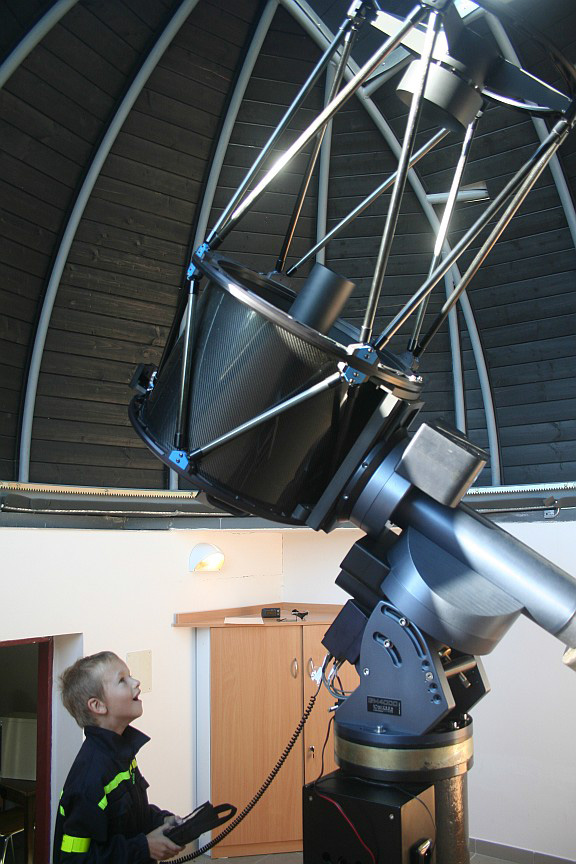
After more than 40 years, the Rokycany Observatory had the opportunity to acquire a new main instrument. The choice fell on a PlaneWave CDK-20 on the equatorial mount GM4000 QCI. We received the first twenty-inch model of this telescope, which was delivered to the Czech Republic via Baader Planetarium and the Prague company Supra. Our observatory is financed by public funds, so it is not really possible to plan when which project can be implemented. Shortly after the telescope had been installed in the old observatory dome, we unexpectedly received money for a new dome, so the instrument was dismantled again and installed in the new dome.
The main task of the observatory is to support astronomy education in the Pilsen region. In addition, a group of amateurs has formed around the observatory, most of whom belong to the West Bohemian branch of the Czech Astronomical Society – the telescope should also be available for these association members.
Why does a public observatory actually need a twenty-inch telescope? Isn’t that a bit exaggerated? We believe that it is not only appropriate, but absolutely necessary. When our 15 cm Zeiss Coudé refractor was purchased in the 1960s, this instrument was far superior to most telescopes owned by amateur astronomers. Today, when many amateurs own 20–40 cm GoTo instruments, we wanted to renew this lead. Most visitors are also spoiled by images from Hubble and other large telescopes, so one simply has to offer more than ordinary small instruments if one wants to attract people.
But let us begin with the mount. The basic requirements were ease of use, no worries with alignment, sufficient stability, and accuracy for astrophotography. However, the mount must also withstand the rush of a school class. Compared with smaller Far Eastern mounts, the GM4000 cannot be compared at all – the fact that the entire mass of the twenty-inch telescope can be positioned so precisely, without play and without hysteresis, using fine motions is impressive. With our other GoTo instruments, quite a lot can go wrong – if someone accidentally or deliberately pulls a connector, loosens a locking screw, or simply gives the telescope a good shove, the alignment is lost and you have to start again from the beginning. The GM4000 is not impressed by this; all cable routing is hidden inside the axes, all cable connections are robust, and apart from the hand controller (which you are securely holding in your hand anyway) and the main switch, there are no control elements that anyone could change. For pubescent teenagers, there simply must be no vulnerable points. And the mount should also be resistant to operating errors – after all, the telescope is not only operated by staff with completed degrees in computer science, but also by educational staff and association members. And indeed, operation is child’s play, simpler than with any other instrument I know. The possibility of changing something is limited. Once, after observing for several hours, I accidentally performed “Reset at Home” and the mount could no longer find any object, and my despair was great, but with “Home Search” I was able to restore the alignment immediately. In addition, of course, one can also use the alignment database …
 GM 4000 QCI - Kundenurteil von Ladislav Rehak