www.baader-observatories.com
In the life of an astronomy enthusiast there inevitably comes a moment when one begins to consider whether operating a private observatory might be worthwhile. Whether it is a fixed pier in the garden or a protective structure in the form of a roll-off roof shed or a dome building in the garden. But even there trouble threatens: glaringly bright street lighting, the 24-hour LED lighting in the neighbor’s garden, or “security lighting” with motion detectors that also react to passing cars or nocturnal small animals and illuminate the surroundings brightly.
In such a situation, the only option often left is to move onto the roof of the house, which brings both advantages and disadvantages.
A major challenge is often the issue of building permits and dealing with the authorities. There are hardly any reports about this in the relevant forums, which is why I would like to describe my own experiences. There will probably be no recipe that guarantees success. However, I would like to encourage other astronomy enthusiasts with my experiences to take this step.
The first ingredient: take plenty of time!
https://astrohd.de
Der Bau der Sternwarte war für mich überhaupt der Grund, den Blog zu starten, da ich bei meiner damaligen Recherche über Dachsternwarten kaum Informationen (weder online noch offline) finden konnte. Diese Lücke im Netz wollte ich mit meinem Blog schließenIn der Zeitschrift SuW hatte ich ebenfalls einen Baubericht zur Sternwarte veröffentlicht, SUW Ausgabe 05/16 ab Seite 74.
Ein weiterer zur Baugenehmigung im VDS Journal Nr. 55 ab Seite 122.
Before going to any authority, one should be clear about several aspects. This can save unnecessary work and wasted money:
Careful examination: do I really have to move onto the house roof?
Because almost any other alternative will likely be quicker and cheaper to realize.
Is the situation there (view, light pollution) really better?
Nothing would be more annoying than discovering after completion that the original disturbing influences cannot be avoided up there either.
Would an observatory on the roof be structurally feasible?
At the beginning this does not have to be a detailed calculation, because that will later be required from a professional anyway. But a visual assessment of the situation on site helps to become aware of the size of the observatory and also of the possible instrumentation.
How have other astronomy enthusiasts realized a rooftop observatory?
I learned the most from examples. For this reason, since the beginning of 2013 I contacted other astronomy enthusiasts and traveled not only through the Stuttgart area but also as far as Hanover simply to gather experience. References from the amateur community available on the web helped me greatly.
How will the neighbors react to this idea?
When submitting a building application, especially if it is somewhat unusual, the neighbors are usually consulted by the authorities. Therefore I spoke with all my neighbors beforehand, explained to them what wonderful hobby I pursue and what I therefore plan to build on my roof. In this way it quickly became clear that the likelihood of objections from the neighbors to a building application would be rather low.
-
What type of building application must be submitted?
This varies greatly from one federal state to another, therefore the only option here is to go to the building authority. -
Can and do I want to carry out the construction of the observatory myself, or should I commission companies?
Even though I am skilled in craftsmanship and trust myself to do many things during house construction, the following reasons nevertheless led me to have this work carried out by professionals
For the building application I need an authorized professional anyway who can prepare building plans eligible for approval.
- With a roof opening one always takes certain risks with regard to thermal insulation and watertightness. I definitely did not want to create a thermal bridge or even a “water hole” in my house due to lack of experience and then end up living in a “dripstone cave,” even if it had an observatory on the roof.
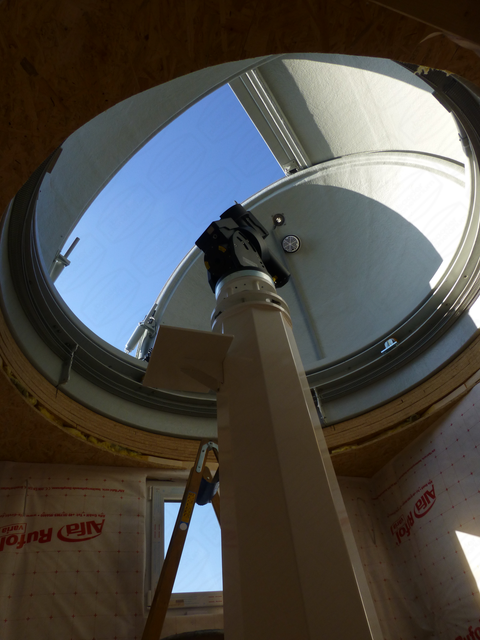
- A dome is never completely wind- and watertight. Therefore, I wanted to place a professionally manufactured dome on my roof so that water would be kept out as perfectly as possible. The team at Baader Planetarium helped me in advance with the planning, and I was completely delighted with the implementation on my roof. I would never have thought how many places need to be glued, insulated, and sealed in order to install a truly watertight dome construction on the roof.